
Hearts
Play Hearts the way most Americans learned it, against three computer players named Maya, Walt, and Rosa, each playing for themselves. Pass three, dodge the Black Lady, and shoot the moon when the cards let you.
How this table works
Before the first deal you see the rules and three options. By default, shooting the moon means everyone else gets 26, the standard rule; the alternative has the shooter take 26 off their own score instead. The Jack of Diamonds bonus is off by default, and the match ends at 100 points, or 50 for a shorter one. You also set the computer players to Easy, Standard, or Expert. Their level never changes during a match, whatever the score.
To pass, tap three cards and press Pass. The cards you receive stay marked in your hand until the first trick is played. To play, tap a card; if you prefer to raise it first and confirm with a second tap, turn on Tap twice to play in Table settings, where you also choose card size, four-color suits, sort order, and speed (Stately, Brisk, or Off).
Undo (key U) takes you back to your last decision in the hand. Hint (key H) raises the card an Expert player would choose. After each hand the summary shows every score, and Show all hands lays out the four hands as they were played.
The Menu holds Replay this deal, Today's deal (the same cards for everyone on a given date), statistics, and Copy deal details. The Classic button swaps the Company's portraits for plain faces. To sit back and let the Company play a hand by itself, watch a hand. The table starts silent; one tap on the speaker button and cards land softly while the Herald's trumpet opens each hand.
The Intermission button
For the moment someone walks up behind you. Press Intermission on the toolbar or the panic key (`, left of 1, unless changed) and ordinary office work covers the hand, or a plain curtain. Where the browser allows, it fills the screen and the tab takes a dull title; Escape twice covers only the window. Press the key again, Escape twice, or the small corner control, and the hand is exactly as you left it. Under Menu, Table settings: Intermission screen (Spreadsheet, Report, Inbox, Dashboard, Project plan, Code editor, Curtain), Go full screen (on or off), and Panic key (`, \, or F2). More on the Intermission.

How to play
Four players, each for themselves, with a standard deck and no trump. Aces are high. Everyone gets 13 cards, dealt one at a time clockwise, and play goes clockwise too. The object is to avoid taking penalty cards: every heart and the Queen of Spades.
The pass
After the deal, each player chooses 3 cards and passes them face down. Nobody sees what they are getting until everyone has chosen. The direction turns over a cycle of 4 hands: the first hand passes left, the second right, the third across, and on the fourth there is no pass (the hold hand). Then the cycle starts over with left. At this table, Maya sits on your left, Walt across, and Rosa on your right.
The first trick
Whoever holds the 2 of Clubs after the pass leads it, no matter who dealt. Everyone must follow with a club if they have one. A player with no clubs may discard, but not a heart and not the Queen of Spades, unless the hand holds nothing but hearts and the Queen. So the first trick is almost always free of points. The Jack of Diamonds is not a penalty card and may be thrown on it.
Following and winning tricks
You must follow suit if you can. If you can't, play anything you like. The highest card of the suit led takes the trick; a discard of another suit never wins, however high it is. The winner of each trick leads to the next. You are never required to discard the Queen of Spades or a heart just because you are void; holding them back is your choice.
Leading hearts
Hearts are broken the moment any heart is played to a trick, by anyone, whether it follows a heart lead or is discarded on another suit. Until then, you may not lead a heart unless your hand holds nothing but hearts. Every other card may be led at any time after the first trick, including the Queen of Spades. The table marks "Hearts broken" on the cloth once it happens, and it resets with each new deal.
Counting the hand
When all 13 tricks have been played, each player counts the penalty cards in the tricks they took: 1 point for each heart and 13 for the Queen of Spades. Without the Jack of Diamonds option, the four players always take 26 points between them. Points add to a running score, and the deal moves one seat to the left.
Shooting the moon
Take every heart and the Queen of Spades in one hand and you have shot the moon. Under the standard rule you score nothing for the hand and each of the other three players adds 26. With the other option chosen, you add −26 to your own score instead and the others add nothing. You don't need to win every trick, only every penalty card; one heart taken by anyone else stops it.
The Jack of Diamonds
With the Jack of Diamonds bonus turned on, whoever takes the Jack of Diamonds adds −10 to their score for the hand. It is applied after the moon is scored and never counts toward a moon. If an opponent takes the jack while you shoot the moon under the standard rule, they add 26 and −10, so the jack softens the blow.
Ending the match
Scores are checked after each hand. When anyone has reached or passed 100 (or the target you chose), the match is over and the lowest score wins. A player can cross the target in a hand that hands the match to someone else, and that is what makes the last few deals so tense.
Scoring
| Card or event | Points |
|---|---|
| Each heart | 1 |
| Queen of Spades | 13 |
| All other cards | 0 |
| Shooting the moon, standard | Shooter 0, each other player 26 |
| Shooting the moon, option | Shooter −26, others 0 |
| Jack of Diamonds, when turned on | −10 |
A worked hand. The match is to 100, default options. Before the hand: You 71, Maya 88, Walt 64, Rosa 79.
- You took 3 hearts: 3 × 1 = 3 points.
- Maya took 4 hearts and the Queen of Spades: 4 + 13 = 17 points.
- Walt took 2 hearts: 2 points.
- Rosa took 4 hearts: 4 points.
- Check: 3 + 4 + 2 + 4 = 13 hearts, and 3 + 17 + 2 + 4 = 26 points. Nobody took them all, so there is no moon.
- New scores: You 71 + 3 = 74, Maya 88 + 17 = 105, Walt 64 + 2 = 66, Rosa 79 + 4 = 83.
- Maya has passed 100, so the match ends. Walt has the lowest score, 66, and wins. You finish second with 74.
Had Walt shot the moon instead, under the standard rule, he would have stayed at 64 while you, Maya, and Rosa each added 26: 97, 114, and 105. Maya and Rosa cross the target and Walt wins by more.
Playing it well
The pass
Start with the Queen of Spades. Keep her only when you hold at least four other spades, all jack or lower: with Q♠ 9♠ 6♠ 3♠ 2♠ you can follow every spade lead low and drop her when it suits you. With Q♠ 5♠ 3♠, pass her.
Never pass your low spades and keep a short queen. Holding Q♠ 4♠ 3♠ and nothing else in spades, pass the queen and keep the 4♠ and 3♠. Passing the two small ones leaves you with a bare queen that the first spade lead pulls out of your hand.
The ace and king of spades are liabilities when you are short in spades: someone will lead spades to flush the queen, and she will land on your ace or king. With A♠ K♠ 7♠ 4♠, pass the ace and king. High hearts work the same way. With A♥ K♥ 9♥ and no heart below the 8, pass the ace and king. With 2♥ 3♥ 5♥ beside them, a high heart is safer to keep, because the low ones get you out of the lead later.
Use any remaining card to make a void. Two or three clubs or diamonds can often go in one pass, and a void is where the queen and your high hearts will go later. Don't try to void spades: the players who pass to you are throwing away their high spades, and you'll be left guarding the queen with nothing.
The play
When points are on the table and you can't avoid following, play the highest card that still loses. The trick so far is the K♦ with a 5♥ sloughed on it; holding Q♦ and J♦, play the queen under the king and keep the jack. When you are last to play and must win the trick anyway, win it with your highest card of the suit. The trick costs the same, and you have shed a card that would have been dangerous later.
If you don't hold the queen, the ace, or the king of spades, lead spades early and often. With 5♠ 3♠ lead the 3♠, then the 5♠. Each round forces the player with the queen closer to playing her on a trick you are not winning. If you do hold the queen, the same leads from someone else are your chance to drop her on a higher spade.
Keep a way out of the lead for the end of the hand. Going into the tenth trick, the 2♥, 3♥, and 4♦ are safe cards; a lone K♦ is not. When you first lead hearts after they break, lead your lowest one, so the other players spend their low hearts while you keep a middle heart for the next round.
Count two things in every hand: whether the queen has fallen, and how many hearts are still out. Once the queen is gone, your high spades can no longer catch her.
The moon, both ways
Watch for a player who takes heart tricks without trying to dodge them, or who leads the top of one suit again and again. Keep one heart or one high card that can win a trick late, and take a single heart on purpose; one heart in your pile spoils the moon, and it costs you a point instead of 26.
Go for the moon yourself only with a hand that can carry it: a long suit headed by the ace and two more high cards, plus most of the high hearts. A♠ K♠ Q♠ J♠ 9♠ 7♠ 4♠ with A♥ K♥ Q♥ 10♥ is such a hand. Pass your low cards, then run the long suit from the top.
Near the end of the match
Watch the scores before you dump the queen. If you are not the low score, giving her to a player who would cross 100 ends the match with someone else winning. If you are the low score, that is exactly the player to give her to. With the Jack of Diamonds bonus on, keep your high diamonds to capture the jack, and don't pass the jack itself.
The Company in Hearts
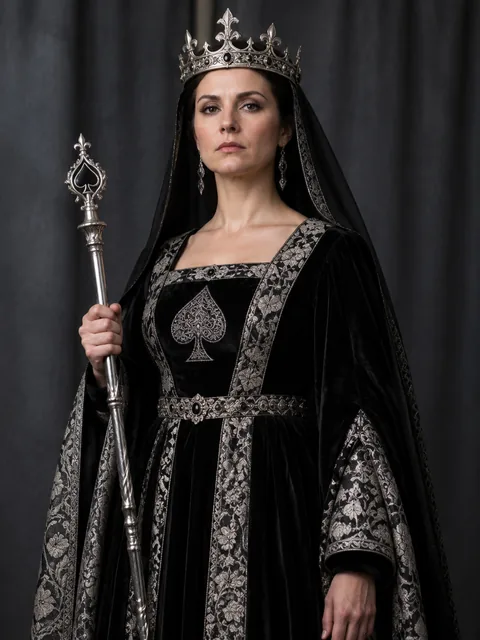
Three moments get their own staging: the first heart played ("Hearts are broken!"), the Queen of Spades walking out alone as the square dims, and a shot moon, which ends the hand in fireworks.
Hearts appeared in the United States in the 1880s, descended from Reversis, a game popular around 1750; The Standard Hoyle of 1887 said it had been played for "the last five years." The Queen of Spades was added as a penalty card in 1909, in a version called Discard Hearts or Black Lady, after her nickname. No one knows for sure why she was picked.
Her traditional French name, Pallas, and the lore of the rest of the court are on the Company page.
Questions players ask
I have only hearts and the Queen of Spades left, and hearts aren't broken. Why can't I lead a heart?
Because your hand isn't only hearts. The exception that lets you lead a heart early applies when every card you hold is a heart; the queen counts as a spade, so she is your one legal lead. Plenty of home games let you lead a heart here, but this table plays the rule as written.
Doesn't the Queen of Spades break hearts?
Not here. Hearts break only when a heart is played. Some printed rules count the queen too, but the version most American players grew up on does not, and that is the one this table follows.
What happens if two players tie for the low score at the end?
The match goes on. Another hand is dealt with the next pass in the cycle, and the scores are checked again afterward. It keeps going until one player has the low score alone.
Can a score go below zero?
Yes. With the Jack of Diamonds bonus or the shooter's −26, a score can drop under zero, and there is no floor. A negative score is simply very good.
Do the computer players know my cards or gang up on me?
No. Each one sees only its own hand, the cards played, the penalty cards each player has taken, and the scores. They don't know which seat is yours, and their decisions about the end of the match treat every player alike, as the fair play page sets out.
Sources
- HeartsPagat (John McLeod)
- How to Play HeartsBicycle Playing Cards
- Card Games/Hearts/StrategyWikibooks
- Hearts (card game)Wikipedia
Last updated