
Kings in the Corner
Play Kings in the Corner against one, two, or three computer players: build the piles down in alternating colors, send every king to a corner, and be the first to play your last card. Penalty points carry from hand to hand until someone reaches the match target.
How this table works
Before the first deal you set the number of computer players (1 computer player by default), the match target (15 points; shorter and longer matches are in the list), when you draw a card (by default, at the start of turn), and whether queens and jacks count 2 (off by default). Ruth, Carl, and Lena fill the seats in that order, all at the level you choose: Easy, Standard, or Expert. Their level never changes during a match.
The stock sits in the middle of the cloth with the four side piles around it and the four corners at the diagonals. Each pile fans out so you can see its first card, which decides where the whole pile may go, and its top card. To draw, tap the stock or press Draw a card. Tap a card in your hand: if it fits only one place it plays at once; if it fits several, the places glow and you tap the one you want. To move a pile, tap it, then tap where it goes. Press End turn when you're done. On a keyboard, D draws, E ends the turn, and the arrow keys with Enter pick cards and piles.
Undo (U) takes back your last decision, and Hint (H) shows what an Expert would do. The Menu holds Replay this deal, Today's deal, statistics, and Copy deal details. Table settings change card size, four-color suits, and speed, and switch to the Classic deck. To let the Company play a match by itself, watch a hand. Sound is off until you tap the speaker button; then kings reach their corners to a short fanfare, and Table settings hold the volume and the Herald's calls.
The Intermission button
For when someone walks into the room: press Intermission on the toolbar, or the panic key (`, left of 1, unless you've changed it), and office work, or a plain curtain, covers the corners and piles. Where the browser allows, it goes full screen and the tab title turns dull; Escape pressed twice covers only the window. The panic key again, Escape twice, or the small corner control brings the round back exactly as it was. Choose under Menu, Table settings: the Intermission screen (Report, Project plan, Spreadsheet, Curtain, Inbox, Dashboard, or Code editor), Go full screen on or off, and the Panic key, `, \ or F2. The whole account.
How to play
This is the table game for 2 to 4 players, also called King's Corner or Kings Corners, not the solitaire with a similar name. It uses one 52-card deck with no jokers. Kings are high and aces are low, and suits don't matter, only color: hearts and diamonds are red, clubs and spades black.
The deal and the layout
The dealer gives 7 cards to each player, one at a time. The next 4 cards go face up to the north, east, south, and west of the stock: these are the side piles. The four corners start empty. What's left is the stock: 34 cards with two players, 27 with three, 20 with four. The player to the dealer's left goes first, play runs clockwise, and the deal moves one seat to the left every hand.
Your turn
With the default timing you draw 1 card from the stock first, and you may play it right away. Then you make as many plays as you like, in any order:
- Build on a pile. A card goes on a pile when it is one rank lower than the top card and the opposite color: a red 9 on a black 10, a black 4 on a red 5. Nothing goes on an ace.
- Start a corner. Only a king can go into an empty corner. After that the corner builds down like any other pile.
- Fill an empty side space. Any card from your hand can go there, a king included.
- Move a whole pile. A side pile can move onto another pile when its first card, the one at the bottom, is one rank lower and the opposite color to the other pile's top card. If the side pile has a red 4 under a black 3, and the east pile runs black 7, red 6, black 5, the red 4 fits on the black 5, so the whole side pile moves and east now runs 7 down to 3. A pile moves whole, never a few cards off the top. Corner piles never move.
You're never required to play, even when a card fits. When you've done what you want, end your turn. With the end-of-turn option, you draw your card then instead, and that card waits until your next turn.
Moving a pile opens a space
When a side pile moves, its space is empty, and you can put any card from your hand into it on the same turn. If a king was dealt to a side space at the start, the player to move can send that pile to an empty corner and then use the space. A pile that starts with a king can never go onto another pile, since nothing is higher; it can only go to an empty corner. At this table a pile can't move into an empty side space. That move would change nothing, since any single card could go there anyway.
Going out
The moment you play the last card from your hand, the hand is over and you've won it. You don't draw afterward. Under the default timing, a player holding one card still draws first and so needs two plays to go out.
When the stock runs out
Nobody draws anymore, and each turn is play or pass. If the stock is empty and every player in turn ends a turn without a single play or pile move, the hand is blocked: nobody wins it, and everyone scores the cards still in hand. It's rare; most hands end long before.
The match
After each hand, the cards left in every hand are scored as penalty points and added to the running totals. When anyone's total reaches the match target, the match ends and the lowest total wins. Reaching the target is how a match ends, not how it's won. If two players share the lowest total at that point, one more hand is played, and the match ends at the first hand with a single lowest total.
Scoring
| Card | Standard | Queens and jacks count 2 |
|---|---|---|
| King | 10 | 10 |
| Queen, jack | 1 | 2 |
| Ace through 10 | 1 | 1 |
| Player who went out | 0 | 0 |
Low is good. A king stuck in your hand costs as much as ten ordinary cards, which is why everyone races to get kings into the corners.
A worked hand. Three players, standard scoring, match target 15. Going in, you have 3 points, Ruth 9, and Carl 6. Ruth plays her last card.
- Ruth went out: 0. Her total stays 9.
- You hold K♣, 7♦, 2♠: 10 + 1 + 1 = 12. Your total: 3 + 12 = 15.
- Carl holds Q♥, J♠, 5♣, A♦: four cards at 1 each = 4. His total: 6 + 4 = 10.
Your 15 reaches the target, so the match ends, and Ruth wins with 9, the only lowest total. With queens and jacks counting 2, Carl's hand would have cost 6 and his total would be 12; Ruth still wins. Had you cornered that king, you'd have scored 2, and the match would have gone on.
Playing it well
Corner kings on sight
A king in your hand is 10 points waiting to happen, and it fits nowhere but a corner or an empty side space. Play it the turn you can. A king in a corner also gives you a home for a queen of the other color.
Move a pile, then use the space
The biggest turns come from opening a space. Say north is 4♥ over 3♣, east runs 7♣ 6♦ 5♠, and your hand includes A♠, 2♥, and 10♦. Move north onto east (the 4♥ fits the 5♠). Now east ends in 3♣: play the 2♥ on it, then the A♠ on the 2♥. North is empty, so the 10♦, which fit nowhere, goes there. Three cards gone, and only the first move made it possible.
Work out the order before you touch anything
Every play changes a top card, and a pile move depends on the top card it lands on. If north is a single 9♠ and east ends in 10♥, putting your 9♣ on east first kills that move. Move north onto east instead, and you get the empty north space as well: the 9♣ can go there, or a card that fits nowhere else can, while the 9♣ waits for the next red 10. Moving first never costs you a card, and it lets you choose which card you keep. Plan the whole turn, then play it.
Shed high cards while they still have homes
Piles only build down, so as the hand goes on there are fewer and fewer places for a jack or a 10, and more for low cards. If you're holding something back, hold the low card: with a 9♥ and a 3♣ both playable, get the 9 down now. Aces are the exception.
Park the card nobody wants
An ace fits only on a 2 of the other color, and nothing builds on it. When you open a space and have nothing better to do with it, an ace or a 2 is the card to put there. Don't count on an ace finding a home late.
Keep a spare
If the only top card you can use is a black 9 and you hold two red 8s, play one and keep the other for the next black 9 that turns up. When one card fits two piles, put it where the new top card suits more of what's left in your hand.
Watch the other hands
Every banner shows how many cards that player holds. When Ruth is down to one or two, stop opening spaces you can't fill yourself: an empty space at the end of your turn takes any card, and it's hers. Merging also removes a build target, so merge when the space is worth more than the pile you lose, and look at what color the next player seems to need before you leave a fresh top card for them.
A king always has a corner waiting
Only kings go into corners, so while you hold a king, at least one corner is still empty. There's never a reason to spend an empty side space on a king: put it in a corner and keep the space for a card that fits nowhere else.
The Company in Kings in the Corner

The cards on the cloth are people standing in the square. When a king comes out, the Herald calls "A king takes his corner!" and the king strides out to his corner of the cloth. When a pile moves, its whole line of performers marches across together as a column. A player down to one card gets a warning from the Herald, and going out brings a flourish on that player's banner; when you go out, there are fireworks.
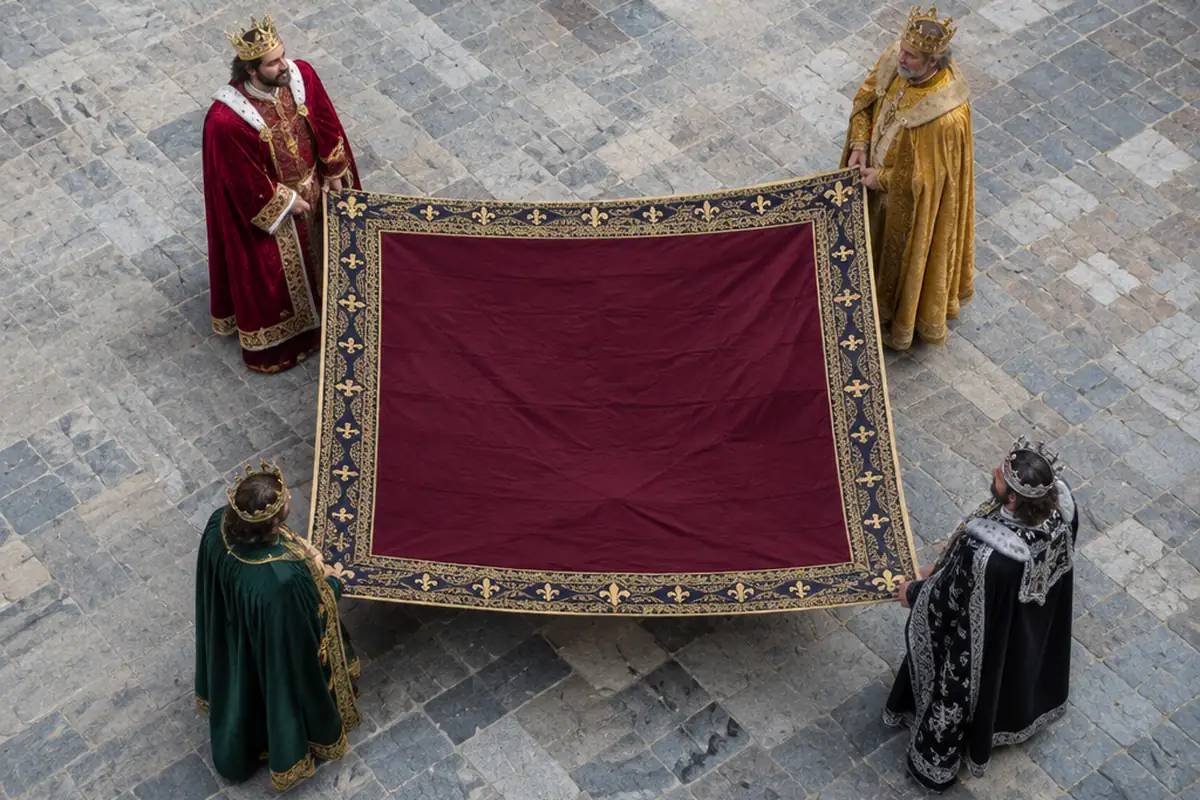
Four corners, four kings, and the faces they wear have a long history. The kings in an American deck come from the English pattern, which descends from cards that Rouen was already exporting to the British Isles in 1480; the pattern stayed conservative for centuries, and its court cards went double-ended only around 1860, according to the International Playing-Card Society. Each king's French name and story are on the Company page.
Questions players ask
Our family made you play any card that fit. Can I play that way?
Not at this table: you may always stop and end your turn. Wikipedia's write-up says playable cards must be played. Pagat lets you play only what you wish. It also mentions a stricter house rule, that a king must be played at the first chance, and notes that nobody can enforce it, since no one else can see whether you're holding one.
Why can't I slide a pile into an empty side space?
Because it wouldn't change anything. The space stays a space, just at a different compass point, and any single card could go into the empty one anyway. Leaving the move out also keeps a turn from dragging on with endless shuffling.
What's the difference between Easy, Standard, and Expert?
An Easy player plays a card that fits at random, never merges two piles (it only sends a king's pile to a corner), and sometimes ends its turn with plays left. A Standard player corners kings at once, sheds high cards first, and moves a pile only to make room for a card that fits nowhere else. An Expert tries every order of plays and pile moves in the turn and picks the one that sheds the most, while avoiding open spaces a nearly empty hand could use.
Do the computer players see my cards or the stock?
No. Each one sees what you see from your chair: its hand, the piles, how many cards everyone holds, and how many are left in the stock, as the fair play page sets out for every game here.
Why did the hand end with nobody going out?
The stock was empty and nobody played a card or moved a pile for a full round. Pagat calls this an impasse: play stops, everyone scores penalty points for the cards still in hand, as at the end of any hand, and the deal moves on.
Sources
- Kings CornersPagat (John McLeod)
- Kings CornerBicycle Playing Cards
- Kings in the CornerWikipedia
- English patternInternational Playing-Card Society
Last updated